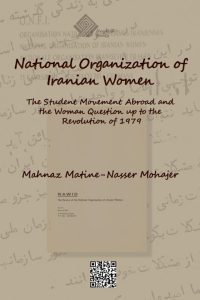
 Mahnaz Matine – Nasser Mohajer
The National Organization of Iranian Women (NOIW), established in January 1965 in close association with the Confederation of Iranian Students, was the first organization founded by Iranian women abroad. The organization did not remain active for long and by the end of the 1960s had all but dissolved.
Research into the history of the first Iranian women’s organization abroad sheds light on the attitude and approach toward the question of women, by an important segment of the leftist and democratic forces that participated in the process. This attitude that evolved in the 1960’s largely informed the disposition adopted by the leftist forces on the women’s issue in the following decades, the consequences of which became apparent especially after the 1979 Revolution.
This book consists of three chapters. The first chapter delves into the origins and the formation of the NOIW, examines the intellectual leanings and ideals of its founders, explores the interplay between the NOIW and the Confederation of Iranian Students, and highlights the achievements of the organization and the problems and obstacles that led to its premature demise. Chapter 2 recounts conversations with several leaders and members of the NOIW, as well as with Majid Zarbakhsh, one of the secretaries of the Confederation who was the principal liaison on behalf of the Confederation with the NOIW. The third chapter is a selection of documents that helps the reader to better understand the rise and fall of the National Organization of Women of Iran.
Category: Diaspora & Exile
-
National Organization of Iranian Women
-
Mommy, where’s your horse?
Batoul Arasteh, Noghteh Books, 2022
 The book interweaves scattered fragments of the life of an urban Iranian woman who, in her youth, is exposed to social justice and democratic ideals, and as a young woman participates in the mass uprisings that culminated in the 1979 Iranian revolution. She joins a leftist political organization as part of the greater revolutionary movement. After Islamic hardliners consolidate their power and unleash a campaign of terror against an array of opposition forces, like thousands of others, she goes underground. As intense state crackdown leads to the disintegration of her political organization, she sees no option but to flee the country. She has to leave her toddler behind, as smugglers lead her, along with her husband and her three-year-old daughter through the treacherous mountains of Kurdistan and into Turkey. After a journey through several European countries, they finally arrive in France where they seek political asylum. And eventually, she’s reunited with her youngest daughter in France.
The author does not delve too much into the details of her political activism in the Islamic Republic of Iran and the organization to which she belonged. Her narrative focuses more on her “inescapable escape” from Iran and the trials and tribulations as an exile including the loss of her mother, father, and a close friend. -

In Exile (Twenty-Three Iranian Short Stories)
Edited by Nasser Mohajer
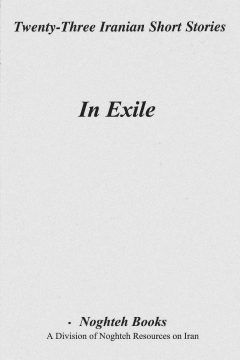
In Exile (Twenty-Three Iranian Short Stories) In this collection, 23 Iranian writers who accepted the call-for-entries by Nasser Mohajer, have recounted stories of life under the theocratic regime of Iran and why people were forced to leave their country and loved ones to seek political asylum in foreign lands. The life and times of political dissidents, nonconformists and non-Muslims are narrated in the labyrinth of displacement. Arranged historically, almost each story is opened with an account of the life in urban settings in Iran. The protagonists recount the horrors of adventurous escapes, frustrations of asylum seeking, as well as the harshness of life, generational battles and predicaments of displacement.
-
Being Known and Yet Unknown
Compiled & edited by Nasser Mohajer
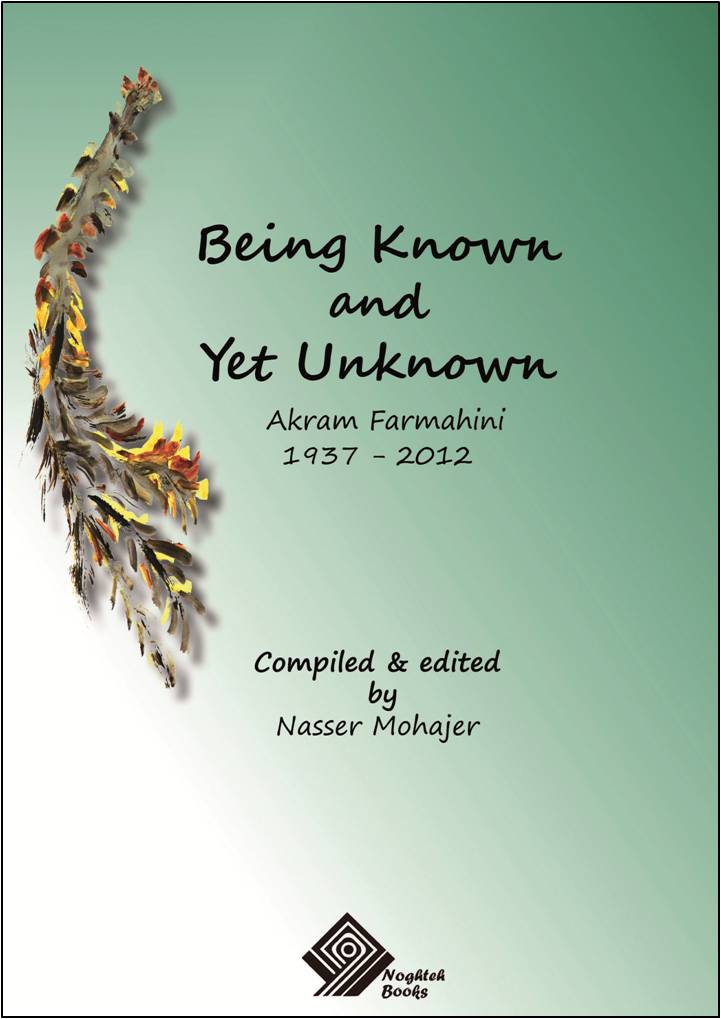 This is a collection of writings by associates, friends and a few relatives of the late Akram Farmahini who passed away in January 2012 in Paris.
Akram Farmahini, artist, painter and designer was educated in the Institute of Decorative Arts of Tehran University. She was married to Bagher Moemani, a well-known historian and public intellectual.
Being Known and Yet Unknown not only introduces the reader to the persona of a female artist, but through different narratives of her life, it depicts achievements as well as obstacles for the advancement of the educated urban middle-class women in the context of the hundred-year transformation of women’s socio-economic conditions specially during the rule of Shah Mohammad Reza Pahlavi. The last chapter of the book features a selection of Akram Faramahini’s paintings and sketches. ISBN: 978-0-9828408-7-0 -
Revisiting Theoretical Questions Concerning the Iranian Feminist Movement
 The pamphlet “Reviewing the Theoretical Discussions of the Women’s Movement at Conferences of the Iranian Women’s Studies Foundation” is based on Mahnaz Matin’s talk at the 30th Conference of IWSF (Florence, Italy, 2019). The conference, entitled “Three Decades of Experiences and Challenges,” was dedicated to reviewing and evaluating nearly 30 years’ experience of IWSF. This review looks at how Islamic Shari’a, the Islamic government, and its engagement in the systematic discrimination against women are discussed in these conferences. Considering the characteristics of the Iranian government in establishing the laws and determining the social relations, particularly in the case of women, under the rubric of applying sharia of Shia Islam, this evaluaon is of undeniable importance to Iran’s feminist movement. The author has reviewed and analyzed the three main trends among Iranian feminists; secular, leftist, and reformist, and explained their views.
 -
Bagher Momeni – Volume 1
A Political and Intellectual Life | Compiled & edited by Nasser Mohajer
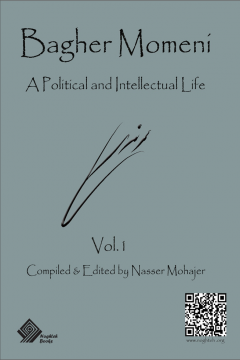 Bagher Momeni (A Political and Intellectual Life)
Vol.1
The first volume contains narratives of personal, political and intellectual life of Bagher Momeni, from the perspective of his relatives, friends and comrades. This volume begins with the selected notes from his older brother and younger sister. Then his former comrades discuss his involvement with and activism in the Tudeh Party from 1941 to 1943. His publicized arrest and detention from 1956 to 1959 are also narrated. His life following the end of his imprisonment, which was jump-started by leaving the Tudeh Party of Iran and turning his attention to historical research, translation of historical texts, literary critique, and cultural work in the final years of the 1960s, is recounted. His political activities during the short window of relative openness, from 1961 to 1964, described by his comrades, are included. We also read the story of the rise and fall of the publication Contemporary Voice (Sedaye Moaser) in addition to the written narratives of the publication’s creators. His travel to France, achievement of a doctorate degree in history, return to Iran, collaboration with several long-time and new comrades at the threshold of the Iranian Revolution, establishment of the weekly publication of Contemporary Voice, and the publication of the theoretical periodical, Thoughts (Andisheh) are recounted. His founding of the Freedom of Labor (Azadi-e Kar) group and finally his forced escape from Iran and adventures during his life in exile are also described.
ISBN: 978-0-9980861-8-7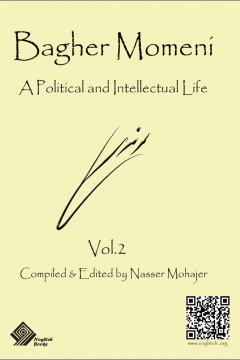 Bagher Momeni (A Political and Intellectual Life)
Vol. 2
The second volume contains the writings of Bagher Momeni, from his first notes dated 1942 to selected political articles that he wrote for the publications of the Tudeh Party up to the August 19, 1953 coup d’état. His accomplishments after the coup are also recounted in numerous works, including poetry, historical inquiries, translations, historical explorations, literary critiques, Islamic studies, and explorations in exile and biographies of friends – published for the first time. This volume contains a deliberate study of Bagher Momeni’s most important work, from his research work to literary critiques and political-social analysis by experts in the field. The newspaper Bistoon-e Kermanshah, which was his first printed press work, is also studied. Thoughts and the weekly Contemporary Voice publications, both cofounded by Bagher Momeni, found their way in the printed press of the country shortly after the Iranian Revolution and are also examined. This volume starts with Momeni’s views on social, political, and cultural issues of his time and ends with his bibliography.
ISBN: 978-0-9980861-8-7This two-volume work is a homage to the intense social, intellectual and political endeavours of Bagher Momeni, one of 20th century Iran’s foremost public thinker and activist. The product of the decade-long efforts of the editor, Nasser Mohajer, who engaged in collecting a broad range of testimonies from collaborators of Momeni spanning the different eras of his presence on Iran’s public scene, these two volumes enable the reader to also gain a vivid impression of the wondrous world of the Iranian Left from the 1940s to the present day.
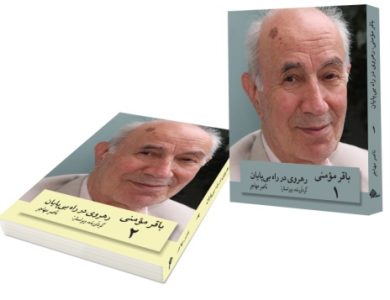 The first volume contains narratives concerned with the personal, political and intellectual life of Bagher Momeni from the perspective of his relatives, friends and comrades. This volume begins with the selected notes from his older brother and younger sister. Then his former comrades discuss his involvement with and activism in the Tudeh Party from 1941 to 1953, including his incarceration between 1956 and 1959. The narrative then takes the reader through Momeni’s activities in the 1960s: from his departure from the Tudeh Party to the start of his historical research, literary criticism and cultural activities within the remit of the Seda-ye Moaser (Contemporary Voice) publishing initiative. The first volume concludes its biographical perspective by noting Momeni’s activities during the Revolution period (1977-79), and his role in several publications produced following the fall of the Shah, such as the Seda-ye Moaser weekly, Andisheh or Thought, and finally his founding of the Azadi-ye Kar, or Freedom of Labour, group before his forced exile from Iran in 1983.
The second volume contains selected writings of Momeni; from his first notes dated 1942 to political articles that he wrote for publications of the Tudeh Party until the August 19 1953 coup d’état. It starts with Momeni’s views on social, political, and cultural issues of his time and ends with a complete bibliography of his remarkable output.
His accomplishments after the coup are also referred to in numerous works, including poetry, historical investigations, translations, literary critiques, Islamic studies, inquiries produced during his exile and biographies of friends, all of which are published for the first time in the present collection. This volume also contains focused studies, conducted by specialists of various fields, of Momeni’s most important intellectual outputs. These studies span his historical and sociological research work through to his literary critiques. The newspaper Bistoon-e Kermanshah, which marked his first involvement with the printed press, is also studied, as well as the aforementioned periodicals published by Momeni after the Revolution of 1979.
This two-volume work finally includes an extended interview by the editor with Momeni, featuring his reflections on 75 years of activism, research and concern for the evolution of Iran’s society and politics, which fittingly bring this unique collection to a close. -
Bagher Momeni – Volume 2
Compiled & edited by Nasser Mohajer
Bagher Momeni (A Political and Intellectual Life)
Vol. 2
The second volume contains the writings of Bagher Momeni, from his first notes dated 1942 to selected political articles that he wrote for the publications of the Tudeh Party up to the August 19, 1953 coup d’état. His accomplishments after the coup are also recounted in numerous works, including poetry, historical inquiries, translations, historical explorations, literary critiques, Islamic studies, and explorations in exile and biographies of friends – published for the first time. This volume contains a deliberate study of Bagher Momeni’s most important work, from his research work to literary critiques and political-social analysis by experts in the field. The newspaper Bistoon-e Kermanshah, which was his first printed press work, is also studied. Thoughts and the weekly Contemporary Voice publications, both cofounded by Bagher Momeni, found their way in the printed press of the country shortly after the Iranian Revolution and are also examined. This volume starts with Momeni’s views on social, political, and cultural issues of his time and ends with his bibliography.
ISBN: 978-0-9980861-8-7Bagher Momeni (A Political and Intellectual Life)
Vol. 1
The first volume contains narratives of personal, political and intellectual life of Bagher Momeni, from the perspective of his relatives, friends and comrades. This volume begins with the selected notes from his older brother and younger sister. Then his former comrades discuss his involvement with and activism in the Tudeh Party from 1941 to 1943. His publicized arrest and detention from 1956 to 1959 are also narrated. His life following the end of his imprisonment, which was jump-started by leaving the Tudeh Party of Iran and turning his attention to historical research, translation of historical texts, literary critique, and cultural work in the final years of the 1960s, is recounted. His political activities during the short window of relative openness, from 1961 to 1964, described by his comrades, are included. We also read the story of the rise and fall of the publication Contemporary Voice (Sedaye Moaser) in addition to the written narratives of the publication’s creators. His travel to France, achievement of a doctorate degree in history, return to Iran, collaboration with several long-time and new comrades at the threshold of the Iranian Revolution, establishment of the weekly publication of Contemporary Voice, and the publication of the theoretical periodical, Thoughts (Andisheh) are recounted. His founding of the Freedom of Labor (Azadi-e Kar) group and finally his forced escape from Iran and adventures during his life in exile are also described.
ISBN: 978-0-9980861-8-7 -
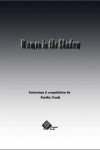
Women in the Shadow
Compiled by Fariba Iraj
 Five young women from one of the provinces in Iran, whose husbands were either imprisoned or executed during the rampant repression of the 1980s, recounted their traumatic experiences with Fariba Iraj. First one on one, and then in a group everyone shared their stories.
The following is what Fariba Iraj says about this innovative and unique approach:
“Aside from two of the women, I didn’t know the rest. I had better say that I had only heard of their names and few things about their lives. For example, I had heard of the hardship that Ladan had to go through in order to visit her husband. She had to travel in extreme heat and cold weather to visit him in one of Tehran’s prisons. On several occasions she was not even allowed to see her husband. I had also heard that she had to endure mistreatments at the hands of prison officials. She would put up with these mistreatments, and would not utter a word. Here and there, I had also heard things about Azadeh that were disturbing. After her husband’s execution, she was being pressured by her mother and father in-laws to marry her brother-in-law. I had heard of stories about her resisting them. Ava’s story was also one of my preoccupations. How she was able to live in hiding with a two-year-old child and escape from one city to another. I wanted to know these women and listen to their stories. I felt that it was their womanhood that made me sensitive to their predicament. I could see that the men around me did not face similar problems, and if they did, they would respond differently.” -
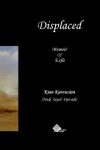
Displaced
Kian Katouzian (Haj Seyed Javadi)
 Displaced (Memoir of Exile)
Displaced is basically Ms. Katouzian’s memoirs of life in exile. The chronicle of a known teacher in Tehran and principal of a prestigious girls school of the 1960s and 1970’s, and also the espouse of one of the renowned dissident intellectuals of the time, Ali Asghar Haj Seyed Javadi.
Displaced is indispensable for the understanding of the sorrows and joys, as well as the triumphs and setbacks experienced by Iranian intellectuals who were in the opposition to the emerging theocracy in the early 1980’s and ultimately had to flee their beloved country after the fundamentalist forces decided to extinguish all voices of dissent.
Ms. Katouzian Memoirs of Exile also helps understand the milieu of exiled Iranian intellectuals residing in Paris through- out 1980’s. -

Sketches of a Friendship
Hamed Shahidian
Edited by Nasser Mohajer | Sketches of a Friendship (Living Revolution and Exile) This book represents the late prominent sociologist, Hamed Shahidian’s (1938-1993) reflections on his relationship with a friend and mentor, Toosi Tabatabaei.
It is a compressed impression of exchange of ideas between two thinkers regarding gender relations in Iranian society (past and future). It is a rigorous probe of concepts such as love, literature, revolution, intellectuality and the agency of intellectuals and life in exile.
The book is bilingual (English and Persian). -

The Inescapable Escape – Volume 1
Edited by Cyrus Javidi, Mahnaz Matine, Nasser Mohajer, Mihan Rousta
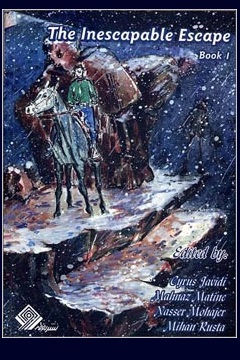 The Inescapable Escape (Thirty Narratives of Fleeing the Islamic Iran)
Book 1
In this two-volume book, thirty men and women of all ages and walks of life with diverse political and religious believes talk about their motivations for fleeing Iran. The protagonists have fled Iran through different borders, seeking asylum in different countries.
The editors and compilers of these amazingly authentic and awakening stories hope to contextualize and pass on the experience of inescapable escape of the older generation to new ones in the hope of preventing historical amnesia and not letting bitter memories and dark days be forgotten.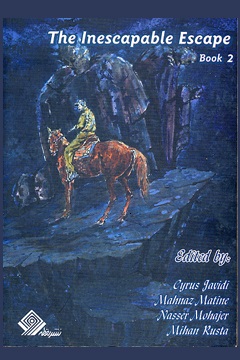 The Inescapable Escape (Thirty Narratives of Fleeing the Islamic Iran)
Book 2
Many left-leaning and non-leftist activists, writers, poets, intelectuals, but also followers of different religious persuasions such as Zoroastrians, Christians, Jews, Bahai’s and those who hoped for freedom and the rule of law had to leave Iran soon after the establishment of the Islamic Republic of Iran. This explains the diverse character of the Iranian Diaspora.
The art work of renowned Iranian Artist, Ario Mashayekhi, depicting moments of displacement has rendered the two volumes of The Inescapable Escape, a rare character. -

The Inescapable Escape – Volume 2
Edited by Cyrus Javidi, Mahnaz Matine, Nasser Mohajer, Mihan Rousta
The Inescapable Escape (Thirty Narratives of Fleeing the Islamic Iran)
Book 1
In this two-volume book, thirty men and women of all ages and walks of life with diverse political and religious believes talk about their motivations for fleeing Iran. The protagonists have fled Iran through different borders, seeking asylum in different countries.
The editors and compilers of these amazingly authentic and awakening stories hope to contextualize and pass on the experience of inescapable escape of the older generation to new ones in the hope of preventing historical amnesia and not letting bitter memories and dark days be forgotten.The Inescapable Escape (Thirty Narratives of Fleeing the Islamic Iran)
Book 2
Many left-leaning and non-leftist activists, writers, poets, intelectuals, but also followers of different religious persuasions such as Zoroastrians, Christians, Jews, Bahai’s and those who hoped for freedom and the rule of law had to leave Iran soon after the establishment of the Islamic Republic of Iran. This explains the diverse character of the Iranian Diaspora.
The art work of renowned Iranian Artist, Ario Mashayekhi, depicting moments of displacement has rendered the two volumes of The Inescapable Escape, a rare character.

-
From Tehran to Stalin-abad
Edited by Nasser Mohajer
From Tehran to Stalinabad (Mohammad Torbati)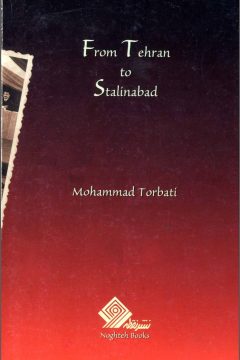 This book is Mohammad Torbati’s memoirs of 50 years of political activity within and without Iran’s Tudeh Party. He joined this pro-Moscow left wing party in the year 1943. He was forced to live underground after the 1953 military coup against the democratic government of Dr. Mohammad Mossadegh.
Torbati escaped Iran for the USSR in 1955. He lived in Ashgabat, Dushanbeh and Moscow until he moved to Prague in 1957. Here he resumed his political activities with the Tudeh party and attended the party’s seventh plenum. But soon after he became disenchanted with the Tudeh Party and upon the party’s 11th plenum in 1965, he took distance from it and focused on academic studies. He graduated from the Academy of Science in 1966 and started working as a researcher at the Prague Economic Institute.
At the time of what is known as the Prague Spring in 1968, he sided with the pro-democracy wing of the communist party and after the suppression of that progressive movement he left both the Communist Party of Czechoslovakia and the Tudeh Party of Iran.
Torbati returned to Iran after the 1979 revolution but could not tolerate the newly established theocracy and soon returned to Prague.
His memoirs is one of the best documentations of the Tudeh Party’s history from the perspective of a low ranking party member.