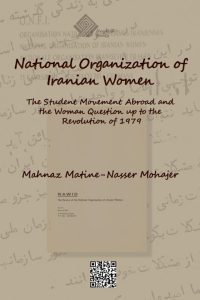
 Mahnaz Matine – Nasser Mohajer
The National Organization of Iranian Women (NOIW), established in January 1965 in close association with the Confederation of Iranian Students, was the first organization founded by Iranian women abroad. The organization did not remain active for long and by the end of the 1960s had all but dissolved.
Research into the history of the first Iranian women’s organization abroad sheds light on the attitude and approach toward the question of women, by an important segment of the leftist and democratic forces that participated in the process. This attitude that evolved in the 1960’s largely informed the disposition adopted by the leftist forces on the women’s issue in the following decades, the consequences of which became apparent especially after the 1979 Revolution.
This book consists of three chapters. The first chapter delves into the origins and the formation of the NOIW, examines the intellectual leanings and ideals of its founders, explores the interplay between the NOIW and the Confederation of Iranian Students, and highlights the achievements of the organization and the problems and obstacles that led to its premature demise. Chapter 2 recounts conversations with several leaders and members of the NOIW, as well as with Majid Zarbakhsh, one of the secretaries of the Confederation who was the principal liaison on behalf of the Confederation with the NOIW. The third chapter is a selection of documents that helps the reader to better understand the rise and fall of the National Organization of Women of Iran.
Category: Women’s Movement in Iran
-
National Organization of Iranian Women
-
Mommy, where’s your horse?
Batoul Arasteh, Noghteh Books, 2022
 The book interweaves scattered fragments of the life of an urban Iranian woman who, in her youth, is exposed to social justice and democratic ideals, and as a young woman participates in the mass uprisings that culminated in the 1979 Iranian revolution. She joins a leftist political organization as part of the greater revolutionary movement. After Islamic hardliners consolidate their power and unleash a campaign of terror against an array of opposition forces, like thousands of others, she goes underground. As intense state crackdown leads to the disintegration of her political organization, she sees no option but to flee the country. She has to leave her toddler behind, as smugglers lead her, along with her husband and her three-year-old daughter through the treacherous mountains of Kurdistan and into Turkey. After a journey through several European countries, they finally arrive in France where they seek political asylum. And eventually, she’s reunited with her youngest daughter in France.
The author does not delve too much into the details of her political activism in the Islamic Republic of Iran and the organization to which she belonged. Her narrative focuses more on her “inescapable escape” from Iran and the trials and tribulations as an exile including the loss of her mother, father, and a close friend. -
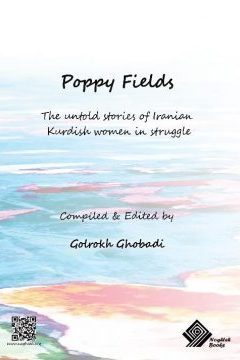
Poppy Fields
 Poppy Fields is concerned with the Struggle of Kurdish women from Iranian Kurdistan during the years following the Iranian Revolution of 1979. Narrated by Goli Ghobadi, one of the first Kurdish women who joined the Movement against the state authorities of the Islamic Republic of Iran, Goli Ghobadi depicts the oppression faced by Kurdish women as well as the evolution of their struggle. The book vividly depicts the challenges of everyday life and the agency of Kurdish women who fought on different fronts and against all kinds of subjugation. Goli Ghobadi also demonstrates how women’s participation in the movement weakened obsolete social structures, especially patriarchy, and paved the way for the formation of new ethnic and gender identities for the Kurdish women of Iran.
 -
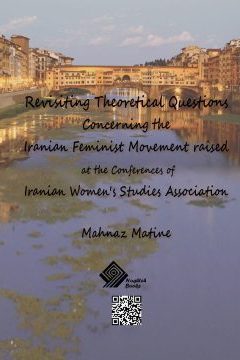
Revisiting Theoretical Questions Concerning the Iranian Feminist Movement
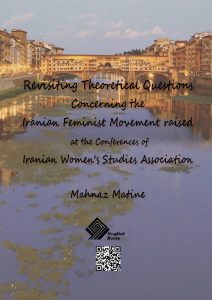 The pamphlet “Reviewing the Theoretical Discussions of the Women’s Movement at Conferences of the Iranian Women’s Studies Foundation” is based on Mahnaz Matin’s talk at the 30th Conference of IWSF (Florence, Italy, 2019). The conference, entitled “Three Decades of Experiences and Challenges,” was dedicated to reviewing and evaluating nearly 30 years’ experience of IWSF. This review looks at how Islamic Shari’a, the Islamic government, and its engagement in the systematic discrimination against women are discussed in these conferences. Considering the characteristics of the Iranian government in establishing the laws and determining the social relations, particularly in the case of women, under the rubric of applying sharia of Shia Islam, this evaluaon is of undeniable importance to Iran’s feminist movement. The author has reviewed and analyzed the three main trends among Iranian feminists; secular, leftist, and reformist, and explained their views.
 -

The Road Not Taken – Volume 1
Compiled & edited by Touraj Atabaki & Nasser Mohajer
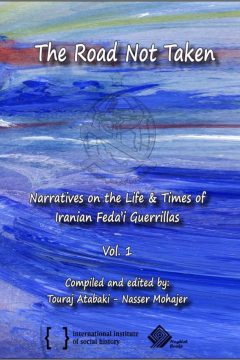 The Road Not Taken (Narrative on the Life & Times of Iranian Feda’i Guerrillas)
Vol.1
For a careful and comprehensive study of the Organization of the Iranian People’s Feda’i Guerrillas (OIPFG) from its inception to the fall of the Shah’s regime on February 11, 1979, two well-known Iranian historians, both living in exile requested a number of ex-members of the OIPFG to record their daily life in struggle in the 1970’s. They also asked scholars and experts in social and political history, labor movement and the arts and letters to appraise the impact of the Guerilla Movement on poetry, short stories, cinema, theatre and music, prior to the Iranian Revolution of 1979.
ISBN: 978-0-9980861-2-5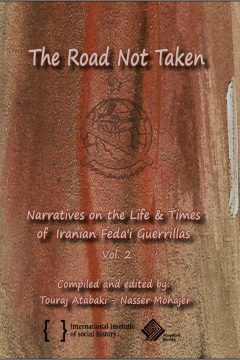 The Road Not Taken (Narrative on the Life & Times of Iranian Feda’i Guerrillas)
Vol. 2
The ties of the OIPFG with the workers movement, its organic relationship with the student movement and liaison with the prison network affiliated with the Feda’ian are narrated by both female and male members and sympathizers of the Organization. So is day to day life in the safe houses of the Fedai’s.
The editors would have wished to include a narrative on the National and Ethnic question in Iran, as well as the rapport with members of non-Muslim communities in the country. But the could not “fill this gap unfortunately”.
The long list of contributors to this two-volume work attests to the editor’s commitment to pluralism and polyphonic historiography. They did their best to give voice to a rainbow of different perspectives and narratives for the better understanding of the historical phenomena named the Feda’i Guerrillas.
ISBN: 978-0-9980861-3-2The Road Not Taken is a narrative of the Life and times of the Organization Iranian Peoples Fedai’e Guerrillas, which came into being in 1971 and carried out armed struggle against the regime of Mohammad Reza Shah Pahlavi until its downfall in 1979.
The book is a comprehensive compilation of the narratives of former guerrillas and ex political prisoners who describe daily life in safe houses, the way in which they conducted armed operations, their engagement in political and intellectual endeavors and political entanglement groups not subscribing to guerrilla warfare. The editors of The Road Not Taken, Touraj Atabaki and Nasser Mohajer, along with other political, economic and social historians of Modern Iran and experts on literature, cinema and the arts have vividly depicted the impact of the OIPFG on the poetry, music, fiction, theater, cinema and painting of 1970s Iran as well as their influence on the working class, student movement and the intelligentsia in particular. -
The Road Not Taken – Volume 2
Compiled & edited by Touraj Atabaki & Nasser Mohajer
The Road Not Taken (Narrative on the Life & Times of Iranian Feda’i Guerrillas)
Vol.1
For a careful and comprehensive study of the Organization of the Iranian People’s Feda’i Guerrillas (OIPFG) from its inception to the fall of the Shah’s regime on February 11, 1979, two well-known Iranian historians, both living in exile requested a number of ex-members of the OIPFG to record their daily life in struggle in the 1970’s. They also asked scholars and experts in social and political history, labor movement and the arts and letters to appraise the impact of the Guerilla Movement on poetry, short stories, cinema, theatre and music, prior to the Iranian Revolution of 1979.
ISBN: 978-0-9980861-2-5The Road Not Taken (Narrative on the Life & Times of Iranian Feda’i Guerrillas)
Vol. 2
The ties of the OIPFG with the workers movement, its organic relationship with the student movement and liaison with the prison network affiliated with the Feda’ian are narrated by both female and male members and sympathizers of the Organization. So is day to day life in the safe houses of the Fedai’s.
The editors would have wished to include a narrative on the National and Ethnic question in Iran, as well as the rapport with members of non-Muslim communities in the country. But the could not “fill this gap unfortunately”.
The long list of contributors to this two-volume work attests to the editor’s commitment to pluralism and polyphonic historiography. They did their best to give voice to a rainbow of different perspectives and narratives for the better understanding of the historical phenomena named the Feda’i Guerrillas.
ISBN: 978-0-9980861-3-2 -
Iranian Women’s Uprising March 8th 1979 – Volume 1
Mahnaz Matine & Nasser Mohajer
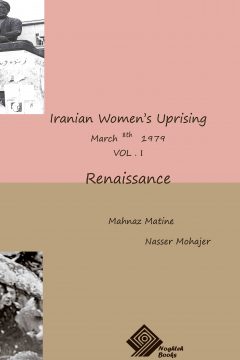
Iranian Women’s Uprising
(Vol. 1 – Renaissance)
This two-volume book is the untold account of the March 8, 1979 peaceful uprising of the Iranian women, pouring into the streets of Tehran protesting against Ayatollah Khomeini’s call for mandatory veiling of Iranian women working in the public sector and educational institutions. This first massive protest movement to the rule of Shiite clergy and the Islamization of Iran, was soon joined by women and also men of six major cities throughout the country and lasted for six days.
The extensive research for this book includes an enormous collection of hundreds of old and newly published magazine articles, newspaper reports written in Persian, English, French and German, video clips, photos, footages and also a few pamphlets and booklets written on the subject. The first volume also contains the testimonies of some of the organizers and participants of this historic uprising who were from all walks of life, such as students, civil servants, academics, lawyers, activists, house wives, nurses, workers and…
ISBN: 978-0-9828408-1-8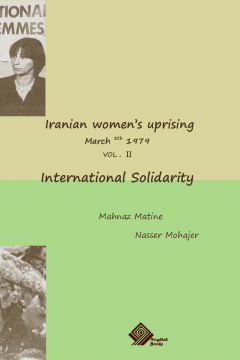 Iranian Women’s Uprising
(Vol. 2 – International Solidarity)
The second volume of Iranian Women’s uprising, archives the extensive international support and solidarity lent to Iranian women in struggle by women’s associations, prominent feminists, and women’s right activists . Hundreds of gatherings and marches were organized in cities like Rome, Milan, Barcelona, New York, Montreal, Vancouver and many others across the world to support the Iranian women’s uprising of March 1979.
The co-editors of these two volumes, Ms. Mahnaz Matine and Mr. Nasser Mohajer have concluded that: “although internationally the uprising enjoyed a great deal of support and solidarity, unfortunately the entire political spectrum in Iran including the liberals, left forces and the centrist individuals and parties did not recognize the importance and potentialities of the uprising, and consequently did not support its sole demand which was to rescind the mandatory Hejab for women and respect for individual liberties.” ISBN: 978-0-9828408-0-1 -
Iranian Women’s Uprising March 8th 1979 – Volume 2
Mahnaz Matine & Nasser Mohajer
Iranian Women’s Uprising
(Vol. 1 – Renaissance)
This two-volume book is the untold account of the March 8, 1979 peaceful uprising of the Iranian women, pouring into the streets of Tehran protesting against Ayatollah Khomeini’s call for mandatory veiling of Iranian women working in the public sector and educational institutions. This first massive protest movement to the rule of Shiite clergy and the Islamization of Iran, was soon joined by women and also men of six major cities throughout the country and lasted for six days.
The extensive research for this book includes an enormous collection of hundreds of old and newly published magazine articles, newspaper reports written in Persian, English, French and German, video clips, photos, footages and also a few pamphlets and booklets written on the subject. The first volume also contains the testimonies of some of the organizers and participants of this historic uprising who were from all walks of life, such as students, civil servants, academics, lawyers, activists, house wives, nurses, workers and…. ISBN: 978-0-9828408-1-8Iranian Women’s Uprising
(Vol. 2 – International Solidarity)
The second volume of Iranian Women’s uprising, archives the extensive international support and solidarity lent to Iranian women in struggle by women’s associations, prominent feminists, and women’s right activists . Hundreds of gatherings and marches were organized in cities like Rome, Milan, Barcelona, New York, Montreal, Vancouver and many others across the world to support the Iranian women’s uprising of March 1979.
The co-editors of these two volumes, Ms. Mahnaz Matine and Mr. Nasser Mohajer have concluded that: “although internationally the uprising enjoyed a great deal of support and solidarity, unfortunately the entire political spectrum in Iran including the liberals, left forces and the centrist individuals and parties did not recognize the importance and potentialities of the uprising, and consequently did not support its sole demand which was to rescind the mandatory Hejab for women and respect for individual liberties.” ISBN: 978-0-9828408-0-1 -
The Peyke Saadat Nesvan
Compiled & anntated by Banafsheh Massoudi & Nasser Mohajer
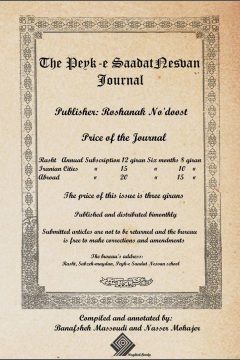 The Peyke Saadat Nesvan (Journal)
The Payk-e Saadat Nesvan Magazine was the first journal published by Iranian women’s rights activists and the first journal produced by left-leaning women in Iran. Its concessioner, Rooshanak Nodoost, was one of the most progressive women of her time whose life story is included in the preface by Banafsheh Massoudi and Nasser Mohajer. She was also the principal of the Saadat Nesvan School in Rasht about which newfound information is included in the 42-page preface.
The Payk-e Saadat Nesvan Magazine was first published in September of 1927, till August of 1928, six issues were distributed in major cities in Iran, reaching women’s rights advocates.
This debut republication of the six issues includes annotations and elucidations by the editors which shed light on hidden aspects of the hundred-year-old history of Iranian women’s struggle for equal rights and human dignity.
ISBN: 978-0-9828408-3-2 -

Women in the Shadow
Compiled by Fariba Iraj
 Five young women from one of the provinces in Iran, whose husbands were either imprisoned or executed during the rampant repression of the 1980s, recounted their traumatic experiences with Fariba Iraj. First one on one, and then in a group everyone shared their stories.
The following is what Fariba Iraj says about this innovative and unique approach:
“Aside from two of the women, I didn’t know the rest. I had better say that I had only heard of their names and few things about their lives. For example, I had heard of the hardship that Ladan had to go through in order to visit her husband. She had to travel in extreme heat and cold weather to visit him in one of Tehran’s prisons. On several occasions she was not even allowed to see her husband. I had also heard that she had to endure mistreatments at the hands of prison officials. She would put up with these mistreatments, and would not utter a word. Here and there, I had also heard things about Azadeh that were disturbing. After her husband’s execution, she was being pressured by her mother and father in-laws to marry her brother-in-law. I had heard of stories about her resisting them. Ava’s story was also one of my preoccupations. How she was able to live in hiding with a two-year-old child and escape from one city to another. I wanted to know these women and listen to their stories. I felt that it was their womanhood that made me sensitive to their predicament. I could see that the men around me did not face similar problems, and if they did, they would respond differently.” -

Displaced
Kian Katouzian (Haj Seyed Javadi)
 Displaced (Memoir of Exile)
Displaced is basically Ms. Katouzian’s memoirs of life in exile. The chronicle of a known teacher in Tehran and principal of a prestigious girls school of the 1960s and 1970’s, and also the espouse of one of the renowned dissident intellectuals of the time, Ali Asghar Haj Seyed Javadi.
Displaced is indispensable for the understanding of the sorrows and joys, as well as the triumphs and setbacks experienced by Iranian intellectuals who were in the opposition to the emerging theocracy in the early 1980’s and ultimately had to flee their beloved country after the fundamentalist forces decided to extinguish all voices of dissent.
Ms. Katouzian Memoirs of Exile also helps understand the milieu of exiled Iranian intellectuals residing in Paris through- out 1980’s. -

Trembling
Farideh Zebarjad
 Tremblings (Memoir)
Tremblings captures the author’s life experiences in the 80’s and 90’s; But at same time, her life resembles the lives of many women of her generation. A young generation who lived the experience of the 1979 Revolution with immense passion, but soon became disillusioned by the outcome of the Revolution.
In the introduction to the book, the author writes: “I was lost. To find myself, I was knocking on every door. I had to write about me, the person who had been lost … the result is what you see before you. These bits and pieces of writings are based on intuition; the overwhelming issues that I had been apparently grappling with for many years, were yearning for an outlet to be expressed… why this form of expression? How consciously did I select this form? I only know whenever I write a letter, I use the same style.” -

The Inescapable Escape – Volume 1
Edited by Cyrus Javidi, Mahnaz Matine, Nasser Mohajer, Mihan Rousta
 The Inescapable Escape (Thirty Narratives of Fleeing the Islamic Iran)
Book 1
In this two-volume book, thirty men and women of all ages and walks of life with diverse political and religious believes talk about their motivations for fleeing Iran. The protagonists have fled Iran through different borders, seeking asylum in different countries.
The editors and compilers of these amazingly authentic and awakening stories hope to contextualize and pass on the experience of inescapable escape of the older generation to new ones in the hope of preventing historical amnesia and not letting bitter memories and dark days be forgotten.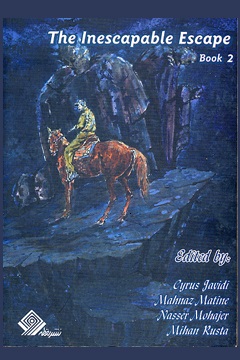 The Inescapable Escape (Thirty Narratives of Fleeing the Islamic Iran)
Book 2
Many left-leaning and non-leftist activists, writers, poets, intelectuals, but also followers of different religious persuasions such as Zoroastrians, Christians, Jews, Bahai’s and those who hoped for freedom and the rule of law had to leave Iran soon after the establishment of the Islamic Republic of Iran. This explains the diverse character of the Iranian Diaspora.
The art work of renowned Iranian Artist, Ario Mashayekhi, depicting moments of displacement has rendered the two volumes of The Inescapable Escape, a rare character. -

The Inescapable Escape – Volume 2
Edited by Cyrus Javidi, Mahnaz Matine, Nasser Mohajer, Mihan Rousta
The Inescapable Escape (Thirty Narratives of Fleeing the Islamic Iran)
Book 1
In this two-volume book, thirty men and women of all ages and walks of life with diverse political and religious believes talk about their motivations for fleeing Iran. The protagonists have fled Iran through different borders, seeking asylum in different countries.
The editors and compilers of these amazingly authentic and awakening stories hope to contextualize and pass on the experience of inescapable escape of the older generation to new ones in the hope of preventing historical amnesia and not letting bitter memories and dark days be forgotten.The Inescapable Escape (Thirty Narratives of Fleeing the Islamic Iran)
Book 2
Many left-leaning and non-leftist activists, writers, poets, intelectuals, but also followers of different religious persuasions such as Zoroastrians, Christians, Jews, Bahai’s and those who hoped for freedom and the rule of law had to leave Iran soon after the establishment of the Islamic Republic of Iran. This explains the diverse character of the Iranian Diaspora.
The art work of renowned Iranian Artist, Ario Mashayekhi, depicting moments of displacement has rendered the two volumes of The Inescapable Escape, a rare character.

-
The National Union of Iranian Women
Compiled & edited by Mahnaz Matine
 The National Union of Iranian Women (Revisited)
The theme of this book is about the formation and activities of the National Union of Iranian Women, which was founded a few weeks after the 1979 February Revolution of Iran. Most of the founders of NUIW were left-leaning women educated in North America and Western Europe and active in the struggle against the Shah’s dictatorial regime. The NUIW was dissolved after the onslaught of the Islamic Republic on all democratic forces of the country in June 1981.
A detailed report written soon after the dissolution of NUIW by a few of its founding members and expounded by some others, give this book a historical value. The memoirs of several other members and activists of NUIW who responded to the questions and queries of Mahnaz Matine, complement the detailed report. Matine’s comprehensive preface contextualizes the endeavors as well as the negligence of NUIW in the face of a Muslim fundamentalist theocracy determined to marginalize Iranian women and push them back to pre-modern times. The documents she has meticulously collected and incorporated in the last chapter of the book sheds light on the rise and fall of the most militant and avant-garde women’s organization of post-revolutionary Iran.